
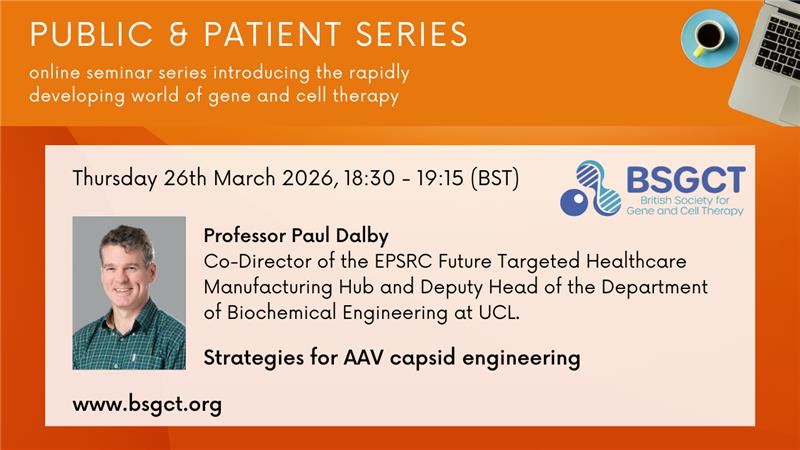
Strategies for AAV capsid engineering
AAV is a promising delivery vehicle for gene therapies with potential to be engineered for improved targeting, higher potency and lower immunogenicity. However, challenges also remain to improve their manufacturing and stability to achieve lower costs and ease of formulation and delivery. Protein engineering provides a viable route to creating platform vectors ready-made for low cost manufacture and high dose formulation. Several protein engineering strategies will be presented for achieving this goal including guidance by bioinformatics, physical structure calculations, molecular dynamics simulations, machine learning, and generative-AI. New vector designs achieve improved stability, transduction efficiency, manufacturing production yield.
SPEAKER
Prof Paul Dalby is Co-Director of the EPSRC Future Targeted Healthcare Manufacturing Hub, and Deputy Head of the Department of Biochemical Engineering at UCL. Paul’s research focuses on technologies to improve the design and formulation of therapeutic proteins and gene therapy vectors, to improve their manufacture, stability, delivery and function. He has pioneered smart directed evolution approaches that accelerate evolution in the lab. Recent work has used molecular dynamics simulations and computational protein design tools to guide stability and function modifying mutations into proteins and viral vectors.
The joining link will be sent to you upon registration.