Biography: Casey is a 4th year MSci Biochemistry (Molecular Biology) with a Year in Industry…

Researcher Spotlight – Wenran Wang
Biography:
I am a pharmacy student at University College London with a strong interest in molecular biology and neuropharmacology. My studies have deepened my appreciation of how drugs interact with biological systems, particularly how substrates modulate cell signalling pathways to influence physiological responses. This has inspired me to pursue a career in scientific research focused on bridging fundamental mechanisms with therapeutic applications.
My primary research interests lie in designing artificial substrates to manipulate neurological receptors, with the goal of developing novel treatments for neurodegenerative diseases such as Parkinson’s disease, as well as genetic disorders like congenital muscular dystrophy. These areas represent urgent clinical challenges where innovative solutions could have a transformative impact on patients’ lives.
I am particularly motivated by interdisciplinary research environments that unite curiosity-driven science with practical healthcare applications. Being part of such a community would allow me to expand my knowledge, refine my technical skills, and contribute meaningfully to the development of targeted therapies.
Plans for the future:
In the long term, I aspire to become a professional researcher dedicated to translating laboratory discoveries into clinical advances. My vision is to work collaboratively on projects that advance medical knowledge while ensuring equitable access to treatments. By combining rigorous scientific inquiry with compassion, I aim to contribute to therapies that improve the quality of life for individuals affected by debilitating conditions, bringing hope through evidence-based interventions.
Research:
Congenital Muscular Dystrophies (CMDs) are a group of rare genetic disorders that remain a major unmet medical need. Current gene therapy trials using adeno-associated virus (AAV)-based strategies have mainly focused on Duchenne Muscular Dystrophy, the most common form of CMD, but outcomes have been limited. Importantly, there are more than 20 other CMD subtypes linked to defects in proteins responsible for glycosylating alpha-dystroglycan, for which effective therapies are lacking.
Mutations in the POMT2 gene, which encodes the enzyme protein O-mannosyltransferase 2, cause a wide spectrum of disease severity. At one end, severe forms such as Walker-Warburg syndrome present with profound muscle weakness, delayed development, and significant cognitive impairment. At the milder end, conditions such as limb-girdle muscular dystrophy type 2N still lead to substantial difficulties, including delayed motor milestones, pain with exercise, mobility challenges, and learning disabilities. At present, treatment for POMT2-related disorders is limited to symptom management and supportive care, with no disease-modifying options available.
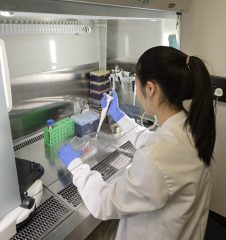
The aim of this project was to design, synthesise, and test in vitro a genetic construct capable of expressing a functional POMT2 gene. The construct was evaluated for its ability to restore activity in cell-based models. Following these assessments, the plan is to incorporate the construct into an AAV vector to enable gene delivery. This will form the basis for future non-clinical studies in POMT2-deficient mouse models, an essential step toward pre-clinical development.
By targeting the root genetic defect, this research seeks to pave the way for a potential therapy that could significantly improve the quality of life for individuals affected by POMT2-related CMDs, moving the field closer to disease-modifying treatments where none currently exist.
What got you interested in gene and/or cell therapy?
My interest in gene and cell therapy grew out of my pharmacy studies at UCL, particularly modules like Clinical Therapeutics in the Central Nervous System. I was fascinated by how precisely genetic and cellular interventions could target disease mechanisms compared to conventional drugs. Readings about AAV based approaches for rare conditions revealed their potential to transform previously untreatable diseases. This inspiration become more personal when I learned about congenital muscular dystrophies, where supportive care is the only option. This possibility that gene therapy could address the root genetic cause rather than only symptoms motivated me to explore the field further. The balance of rigorous science and real patient impact is what excites me most. It represents the type of research I want to contribute to, where curiosity in molecular biology directly translates into better lives for patients.
What findings or opportunities in the field are you most excited about?
I am most excited about the rapid progress in viral vector development, particularly adeno-associated virus (AAV) technology. AAVs have already shown life-changing effects in approved therapies for spinal muscular atrophy, which demonstrates that what once felt theoretical can become reality. The opportunity to apply similar strategies to congenital muscular dystrophies, especially POMT2-related subtypes, is especially inspiring. The idea that carefully designed vectors could restore protein function and rescue muscle integrity represents an extraordinary leap forward for patients with very few options. I am also enthusiastic about interdisciplinary opportunities, combining molecular biology, pharmacology, and clinical insight to refine therapies. The translation from bench to bedside is not only scientifically rewarding but socially impactful, ensuring discoveries reach those in need. This convergence of innovation, collaboration, and patient-focused outcomes is what motivates me to build a career in gene therapy.
What challenges did you face to get where you are now?
My biggest challenge was experimental: we introduced an antibody we hadn’t used before to detect target rescue, so there was uncertainty about specificity, background, and how to interpret the signal. We also completed only a single pilot run, which limited precision and prevented any meaningful statistics.
What is the most important thing you learned during your URB?
The most valuable lesson I learned during my URB was the importance of connecting theoretical knowledge with experimental practice. Heard about how to design an experiment and testing a POMT2 construct taught me that research is not just about technical skill but also about curiosity, resilience, and problem-solving. I gained a deeper appreciation of how small experimental uncertainties, whether in plasmid cloning or gene expression assays, in which it requires carefulness and patience. I also learned the value of asking questions, seeking feedback, and adapting protocols when results were unexpected. Most importantly, I realised that research is a process of incremental progress, where each step builds a foundation for the next. This experience has confirmed that I want to continue in research, as it showed me both the challenges and the excitement of working on projects that could one day become real therapies.
How has being part of the BSGCT community supported your career?
Being part of the BSGCT community has been invaluable in shaping my development as a young researcher. It has given me access to a network of scientists who share a passion for translating discoveries into therapies. Communicating with different people and reading about the society’s initiatives, and preparing my bursary application have all given me a clearer perspective on how gene and cell therapy research progresses from lab concepts to clinical impact. This sense of community has also provided encouragement and inspiration, showing me that even as a student, I can contribute to advancing knowledge in this field. Overall, the BSGCT community has supported my career by opening doors, broadening my horizons, and reinforcing my commitment to pursue research long term.
Related Posts