'Huge congratulations to Jasmine Ardeleanu, runner up of the BSGCT Scientific Writing competition 2026 describing…

BSGCT Scientific Writing Competition – Winner – Jyoti Yadav
‘Massive congratulations to Jyoti Yadav who beat off tough competition to become the Winner of the BSGCT 2026 Scientific Writing Competition with a wonderfully insightful piece on T cell engineering’.
Jyoti Yadav, winner of the BSGCT Scientific Writing competition 2026 describing ‘Teaching Our Own Soldiers to Fight Smarter: Engineering T Cells to Conquer Solid Tumours‘.
Jyoti Yadav – Teaching Our Own Soldiers to Fight Smarter: Engineering T Cells to Conquer Solid Tumours
Jyoti Yadav holds a Master’s degree with research experience in genetic engineering, DNA recombination, Heterologous cloning and sequencing, including laboratory work investigating how specific genes regulate self-tolerance in organisms. She has a keen interest in cancer immunotherapy and the molecular mechanisms that shape immune responses in disease.
Imagine sending a crack military unit into a city designed to repel them at every turn—the roads are blocked, the locals are hostile, and the supply lines are cut off. This is precisely the predicament of CAR T cells when they attempt to fight solid tumours.
Chimeric antigen receptor (CAR) T cell therapy is one of the most exciting advances in modern medicine. It takes a patient’s own immune cells—specifically T cells, the body’s frontline killers—extracts them, genetically engineers them in a laboratory to recognise and destroy cancer cells, and then infuses them back into the patient. In blood cancers like leukaemia, the results have been nothing short of remarkable, with some patients achieving complete remissions. Yet when scientists turn this same powerful weapon against solid tumours—the kind that form in the lung, bowel, liver, or skin the therapy too often falters.
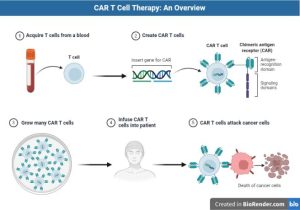
Figure 1:
Why? And, more importantly, what are scientists doing about it? The answer lies in a battlefield called the tumour microenvironment (TME)—and in a new generation of ingeniously engineered cellular therapies designed to overcome it.
A Fortress Designed to Repel Attack
Solid tumours are not passive lumps of rogue cells. They actively construct a protective ecosystem around themselves, the TME, that is deeply hostile to immune cells. Picture a fortress with multiple defensive layers.
First, there are the physical walls. Tumours produce a dense web of proteins called the extracellular matrix (ECM) and recruit ‘cancer-associated fibroblasts’ (CAFs), cells that behave like loyal builders, constantly reinforcing these barriers. Even when T cells arrive at the tumour’s edge, they literally cannot push through [1].
Second, the blood vessels feeding the tumour are chaotic and disorganised, reducing the number of T cells that can even reach the battlefield in the first place [1]. Third, perhaps most cunningly, the tumour recruits traitors from within the immune system itself: regulatory T cells (Tregs), myeloid-derived suppressor cells (MDSCs), and tumour-associated macrophages (TAMs) that actively suppress rather than support the anti-tumour immune response [2,3].
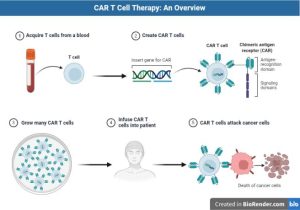
Figure 2:
As if that were not enough, the tumour chemically poisons the environment: low oxygen levels, acidic conditions from tumour metabolism, and a soup of immunosuppressive molecules like TGF-β and IL-10 collectively exhaust any T cells brave enough to infiltrate. Eventually, even the most motivated immune soldier lays down its weapons, a state scientists call ‘T cell exhaustion’ [1,4].
Engineering the Next-Generation Soldier
Rather than abandoning the mission, scientists are re-engineering the soldier. Several creative and promising strategies have emerged from recent research.
One approach involves fitting T cells with better ‘navigation systems’. Tumours secrete chemical signals, chemokines—but standard T cells often lack the matching receptors to respond to them. By genetically equipping CAR T cells with new chemokine receptors (such as CXCR2 or CCR2b), researchers have shown that T cells can now home in on tumour tissue far more effectively in preclinical models [1]. It is the equivalent of giving your soldiers a detailed map of enemy territory.
Another approach arms T cells against the immunosuppressive signals that would otherwise silence them. Scientists have engineered ‘inverted cytokine receptors’ that flip the enemy’s attack into a boost: instead of being suppressed by TGF-β, a newly designed receptor converts that very signal into a survival and activation cue for the T cell [1]. Imagine a soldier whose armour absorbs enemy fire and converts it into extra energy.
Cancer cells also frequently change the antigens displayed on their surface, a strategy called antigen escape, to become invisible to T cells trained against a single target. The solution? Dual-targeting CAR T cells that simultaneously recognise two different tumour markers — so that even if the tumour discards one, the T cell can still engage via the other [4]. Clinical trials in neuroblastoma, a childhood cancer, are testing exactly this approach using GD2 and B7-H3 as dual targets [4].
Vaccines, Checkpoints, and Combination Assaults
Gene and cell therapy does not have to fight alone. Some of the most exciting recent clinical results have come from combining engineered T cells with other immunotherapy tools.
Personalised mRNA cancer vaccines, can train the immune system to recognise a patient’s own unique tumour mutations (called ‘neoantigens’). When combined with anti-PD-1 immune checkpoint blockade—a drug that removes the ‘brakes’ placed on T cells by the tumour—these vaccines have achieved overall response rates of 59% in melanoma patients [1,2]. The KEYNOTE-942 trial recently showed that the mRNA vaccine mRNA-4157, combined with pembrolizumab, significantly prolonged recurrence-free survival in high-risk melanoma after surgery [1].
Meanwhile, the landmark BNT211 trial combined CLDN6-targeted CAR T cells with an mRNA ‘booster vaccine’ specifically designed to expand the CAR T cells inside the patient’s body after infusion — achieving a 33% objective response rate in heavily pre-treated solid tumour patients who had run out of other options [1].
Milestones Already Reached
Progress is not merely theoretical. In 2024, afamitresgene autoleucel (afami-cel), a TCR-engineered T cell therapy targeting the MAGE-A4 antigen—received FDA accelerated approval for advanced synovial sarcoma, a rare but devastating soft-tissue cancer. This was a landmark moment: the first approved T cell receptor therapy for a solid tumour [1]. Tebentafusp, a novel bispecific T cell engager, became the first TCR-based therapy approved for metastatic uveal (eye) melanoma, offering improved survival even with a modest overall response rate [1,2].
In neuroblastoma, anti-GD2 antibody therapy is now standard of care in high-risk paediatric patients, improving event-free survival by approximately 15%. Researchers are now working on second-generation GD2-targeted CAR T cells that co-express cytokines like IL-15 to survive longer inside the body, as well as dual-targeting constructs to prevent antigen escape [4].
The Mission Continues
The war against solid tumours is far from won. The TME remains a formidable adversary, and the challenges of T cell exhaustion, antigen heterogeneity, and physical barriers still demand solutions. But the tools at scientists’ disposal are advancing rapidly smarter navigation, armour against immunosuppression, dual-targeting strategies, and vaccine amplification.
References
[1] Wang Y et al. T cell immunotherapy for solid tumors: limitations, progress, and future prospects. Front. Immunol. 17:1755751 (2026).[2] Ralli M et al. Immunotherapy in the Treatment of Metastatic Melanoma: Current Knowledge and Future Directions. J Immunol Res. 9235638 (2020).
[3] Neophytou CM et al. The Role of Tumor Microenvironment in Cancer Metastasis: Molecular Mechanisms and Therapeutic Opportunities. Cancers 13, 2053 (2021).
[4] Du X, Dong R, Dong K. Factors Influencing Immunotherapy Response in Neuroblastoma: From Tumor Microenvironment to Combination Strategies. Cells 15, 441 (2026).
Related Posts