
'Massive congratulations to Jyoti Yadav who beat off tough competition to become the Winner of the…

BSGCT Scientific Writing Competition – Runner up – Jasmine Ardeleanu
‘Huge congratulations to Jasmine Ardeleanu, runner up of the BSGCT Scientific Writing competition 2026 describing ‘Born Without an Immune System: How Gene Therapy Is Rebuilding Defence From The Inside Out‘.
Jasmine Ardeleanu – Born Without an Immune System: How Gene Therapy Is Rebuilding Defence From The Inside Out
Jasmine is an undergraduate biological sciences student at the Royal Veterinary College with a strong interest in immunology, molecular biology, and the genetic mechanisms underlying disease, and she is passionate about understanding how cellular and genetic pathways influence immune function, disease progression, and therapeutic development. She hopes to pursue a future career in translational research, bridging fundamental biological science with clinical applications, particularly in the areas of immune regulation, inflammatory disease, and genetic disorders.
Born Without an Immune System: How Gene Therapy Is Rebuilding Defence From The Inside Out
Imagine bringing your newborn baby home, only to be told that even a common cold could be life-threatening. For children born with Severe Combined Immunodeficiency (SCID), this was once a reality. In the 1970s and 1980s, some infants spent their early lives in plastic “bubbles” to avoid infection, their futures uncertain. Today, medical science is offering something revolutionary: a way to fix the immune system from within!
What is SCID?
Our immune system is like an army defending the body; two key “soldiers” are white blood cells called T cells and B cells, which recognise and neutralise infections caused by bacteria, viruses, and fungi. In SCID, genetic mutations stop immune cells from developing correctly, leaving children vulnerable to infections that most of us can fend off easily (1). For example, the most common form of SCID is X-Linked SCID, which occurs when a gene needed for immune signalling doesn’t work, so T cells never mature properly and therefore cannot coordinate effective responses against infections (2).
Because the problem is genetic, conventional medicines can only manage symptoms, they don’t restore immune function. That’s where gene therapy comes in.
From “Bubble Babies” to a Genetic Cure
In the 1970s and 1980s, children with SCID gained worldwide attention due to their isolation units that kept them away from pathogens. One of the most well-known cases was that of David Vetter, who lived most of his life in a sterile chamber to avoid infection. Whilst such isolation prevented exposure to germs, it did nothing to fix the underlying genetic problem.
Doctors used bone marrow transplants, harvesting stem cells, to replace missing immune cells, but these required a matching donor, usually a sibling – a fortunate but relatively rare circumstance (3). Many children never found a match in time.
Gene Therapy: A New Approach
Gene therapy takes a fundamentally different approach: rather than providing immune cells from another person, it fixes the child’s own cells. Here’s how it works (Figure 1):
- Harvest hematopoietic stem cells (HSCs) from the child’s bone marrow or blood
- Use a harmless modified virus as a delivery vehicle to insert a healthy copy of the defective gene in a laboratory setting
- Treat the patient’s bone marrow with mild chemotherapy to make space for the new, functional cells
- Return the corrected stem cells to the child’s body via intravenous infusion
- These corrected cells can now develop into functioning T cells and B cells (4)
This approach aims not just to suppress symptoms, but to provide a lasting cure from within.
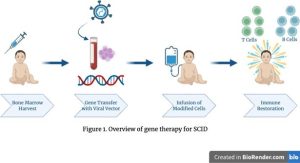
Figure 1: Overview of gene therapy for SCID
Early Success… and Setbacks
Early clinical trials showed promise; some children developed functioning immune systems and could leave the hospital. But then, in a few cases, something alarming happened – some patients had developed leukemia.
Why? The viral vectors used to insert the corrected gene sometimes landed near genes that control cell growth and division, called proto-oncogenes. When this happened, it unintentionally activated those genes and led to uncontrolled cell growth, as seen in Figure 2 (5).
This was a sobering lesson; gene therapy is powerful, but how and where a gene is inserted into the genome matters immensely and although rare, these cases prompted pause and reflection within the field.
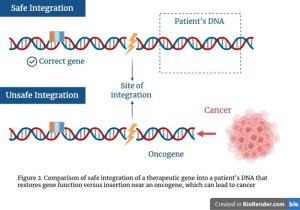
Figure 2: Comparison of safe integration of a therapeutic gene into a patient’s DNA that restores gene function versus Insertion near an oncogene, which can lead to cancer
A Safer Second Generation
Rather than abandoning gene therapy after these early setbacks, scientists returned to the drawing board, focusing on improving the technology. They developed safer viral vectors, delivery mechanisms designed to insert corrected genes more reliably and with lower risk of disturbing other important genes, including self-inactivating viral vectors and improved regulatory elements that limit unwanted gene activation. These new vectors reduce the risk of activating nearby oncogenes, lowering the likelihood of treatment-related cancer (6).
These improvements, combined with careful monitoring of patients, have greatly reduced the risk whilst preserving its ability to restore immune function. As a result, gene therapy for certain forms of SCID is now an approved treatment in several countries (7). Many treated children are able to develop functional immune systems, allowing them to respond to infections and vaccinations and live far more normal lives than previously possible.
From SCID to Broader Medicine
The lessons learned from SCID gene therapy extend beyond a singular condition. Successful strategies in vector design and gene delivery are now informing treatments for other genetic disorders such as Wiskott-Aldrich syndrome (8) and inherited blood disorders such as
β-Thalassemia and sickle-cell disease (9).
Balancing Hope with Realities
While gene therapy offers remarkable promise, it also raises important questions:
- Cost and access: these therapies are technically complex and expensive to manufacture. Who should pay for them and how can they be made accessible worldwide?
- Ethical considerations: as we learn to edit the human genome, where and how these technologies should be applied needs to be assessed carefully.
- Longevity of effect: how long will the corrected gene continue to function? Long-term follow-up studies are essential.
Discussing these wider issues alongside scientific progress helps to ground the narrative, showing not only what gene therapy can do but also how we should think about its place in medicine and society.
Conclusion: A New Beginning
For the families of children born without a functioning immune system, gene therapy has transformed treatment from merely containing the disease to addressing the underlying causes and potentially curing it. Where once the only option was isolation, today there is the possibility of a healthy and normal life, and beyond SCID, the lessons learned are lighting the path for therapies that could one day tackle a wide range of genetic diseases.
References
- Aranda CS, Gouveia-Pereira MP, da Silva CJM, Rizzo MCFV, Ishizuka E, de Oliveira EB, Condino-Neto A. Severe combined immunodeficiency diagnosis and genetic defects. Immunol Rev. 2024 Mar;322(1):138-147. doi: 10.1111/imr.13310. Epub 2024 Jan 29. PMID: 38287514.
- Kumrah R, Vignesh P, Patra P, Singh A, Anjani G, Saini P, Sharma M, Kaur A, Rawat Genetics of severe combined immunodeficiency. Genes Dis. 2019 Jul 24;7(1):52-61. doi: 10.1016/j.gendis.2019.07.004. PMID: 32181275; PMCID: PMC7063414.
- Wahlstrom JT, Dvorak CC, Cowan Hematopoietic Stem Cell Transplantation for Severe Combined Immunodeficiency. Curr Pediatr Rep. 2015 Mar 1;3(1):1-10. doi: 10.1007/s40124-014-0071-7. PMID: 25821657; PMCID: PMC4371740.
- Wadbudhe AM, Meshram RJ, Tidke Severe Combined Immunodeficiency (SCID) and Its New Treatment Modalities. Cureus. 2023 Oct 26;15(10):e47759. doi: 10.7759/cureus.47759. PMID: 38022338; PMCID: PMC10676291.
- Hacein-Bey-Abina S, Garrigue A, Wang GP, Soulier J, Lim A, Morillon E, Clappier E, Caccavelli L, Delabesse E, Beldjord K, Asnafi V, MacIntyre E, Dal Cortivo L, Radford I, Brousse N, Sigaux F, Moshous D, Hauer J, Borkhardt A, Belohradsky BH, Wintergerst U, Velez MC, Leiva L, Sorensen R, Wulffraat N, Blanche S, Bushman FD, Fischer A, Cavazzana-Calvo M. Insertional oncogenesis in 4 patients after retrovirus-mediated gene therapy of SCID-X1. J Clin Invest. 2008 Sep;118(9):3132-42. doi: 10.1172/JCI35700. PMID: 18688285; PMCID: PMC2496963.
- Poletti V, Charrier S, Corre G, Gjata B, Vignaud A, Zhang F, Rothe M, Schambach A, Gaspar HB, Thrasher AJ, Mavilio F. Preclinical Development of a Lentiviral Vector for Gene Therapy of X-Linked Severe Combined Mol Ther Methods Clin Dev. 2018 Mar 10;9:257-269. doi: 10.1016/j.omtm.2018.03.002. PMID: 29707600; PMCID: PMC5918176.
- Aiuti A, Roncarolo MG, Naldini L. Gene therapy for ADA-SCID, the first marketing approval of an ex vivo gene therapy in Europe: paving the road for the next generation of advanced therapy medicinal products. EMBO Mol Med. 2017 Jun;9(6):737-740. doi: 10.15252/emmm.201707573. PMID: 28396566; PMCID: PMC5452047.
- Fischer A, Hacein-Bey-Abina Gene therapy for severe combined immunodeficiencies and beyond. J Exp Med. 2020 Jan 6;217(2):e20190607. doi: 10.1084/jem.20190607. PMID: 31826240; PMCID: PMC7041706.
- Zhang ZY, Thrasher AJ, Zhang Gene therapy and genome editing for primary immunodeficiency diseases. Genes Dis. 2019 Jul 30;7(1):38-51. doi: 10.1016/j.gendis.2019.07.007. PMID: 32181274; PMCID: PMC7063425.
Related Posts